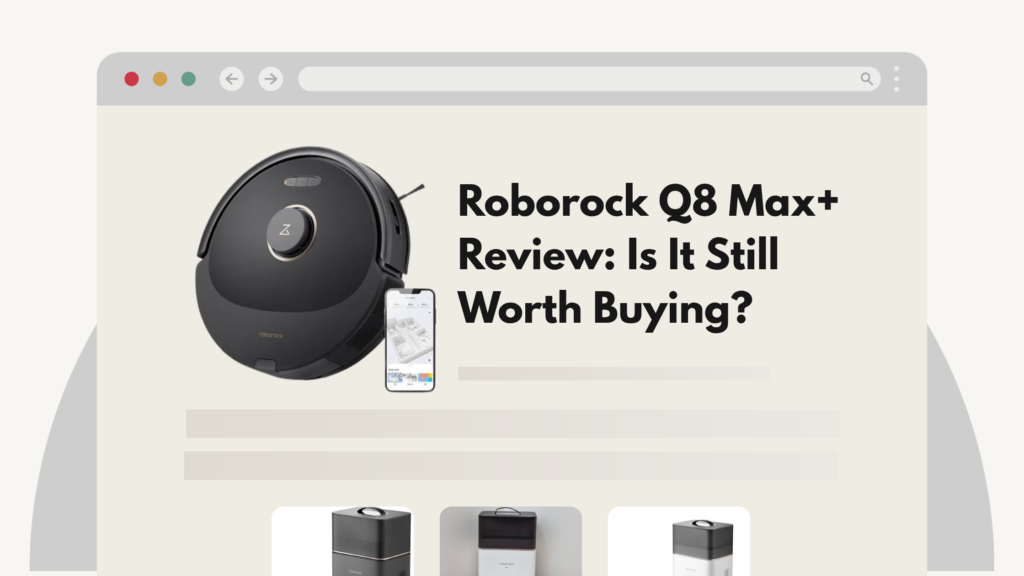
If you searched for an Roborock Q8 Max+ review, there is an important distinction to make first: RTINGZ has reviewed the Roborock Q7 Max+, but it does not currently list a dedicated Q8 Max+ review in its robot vacuum database. That means it would be misleading to attribute Q8 Max+ test results to RTINGZ.
The Roborock Q8 Max+ is a different model and brings several upgrades over the Q7 Max+, including dual rubber rollers, 5,500Pa rated suction, LiDAR navigation, obstacle avoidance and an auto-empty dock.
So what is the Q8 Max+ actually like?
After looking at Roborock’s specifications and independent testing, the picture is fairly clear. The Q8 Max+ is primarily a vacuum-first robot with a basic mopping function, and its strongest features are its navigation, carpet and pet-hair performance, dual-roller design and self-emptying dock.
Roborock Q8 Max+ Specs

- [Automatic Self-Emptying]: Experience enhanced convenience with the Q8 Max+ Self-Emptying feature, featuring a 2.5L dust…
- [Tailor your Mopping]: Different floors and different rooms need different cleaning intensities. Choose how much mopping…
- [Reactive Tech Obstacle Avoidance]: The robot vacuum navigates through your home effortlessly, employing Reactive Techno…
| Feature | Roborock Q8 Max+ |
|---|---|
| Suction power | Up to 5,500Pa |
| Main brush | DuoRoller dual rubber brush |
| Navigation | PreciSense LiDAR |
| Obstacle avoidance | Reactive Tech |
| Battery | 5,200mAh |
| Maximum advertised runtime | Up to 240 minutes |
| Dustbin | 470ml |
| Auto-empty dock | Yes |
| Dock dust bag | 2.5L |
| Mopping | Yes |
| Wi-Fi | 2.4GHz |
| Voice assistants | Alexa, Google Home and Apple Siri |
| App | Roborock app |
Roborock officially lists 5,500Pa suction, DuoRoller brushes, LiDAR navigation, Reactive Tech obstacle avoidance, a 2.5L dust bag and a 5,200mAh battery. The manufacturer also states a maximum runtime of up to four hours under its specified conditions.
Design and Build Quality
The Q8 Max+ has the familiar round robot-vacuum design, with the LiDAR navigation module positioned on top.
The more important design change is underneath.
Instead of one primary roller, the Q8 Max+ uses two rubber rollers that rotate in opposite directions. Roborock calls this the DuoRoller system. The design is intended to improve debris pickup while reducing hair tangling compared with conventional brush arrangements.
The robot also has a combined dustbin and water tank, meaning the same removable assembly handles both vacuuming and mopping duties.
The Q8 Max+ is not built around the more elaborate docking stations found on Roborock’s expensive flagship models. Its dock automatically empties the robot’s dustbin, but it does not wash and dry the mop automatically.
That distinction matters.
You are buying an auto-emptying vacuum dock, not a fully automated vacuum-and-mop station.
Vacuum Cleaning Performance
This is where the Q8 Max+ makes the strongest case for itself.
Independent testing from Modern Castle measured 98.2% overall debris pickup, including 98.5% on hardwood, 97.2% on low-pile carpet and 98.8% on high-pile carpet. Its pet-hair test achieved 100% pickup in that particular test environment.
Those numbers should not be treated as universal results for every home, but they do show why the Q8 Max+ has developed a strong reputation as a vacuum.
The dual-roller system is particularly relevant for homes with pets.
Another independent review found that the Q8 Max+ handled pet hair effectively and performed well across hard floors and carpets, while noting that its mopping system was considerably less impressive.
Hard Floors
Hard floors are an easy environment for the Q8 Max+ to handle.
The combination of strong suction, dual rollers and LiDAR navigation makes it well suited to everyday dust, crumbs, hair and other loose debris.
It can also clean along floor seams, with Roborock specifically describing a cleaning pattern designed to follow hardwood seams and collect debris from gaps.
However, like most round robot vacuums, it should not be expected to perfectly clean every corner.
Modern Castle measured substantially weaker edge cleaning than the robot’s overall debris performance, which is an important limitation if your home tends to collect dust right against walls.
Carpet
The Q8 Max+ is more capable on carpet than its relatively affordable positioning might suggest.
It automatically increases suction when it detects carpet through its Carpet Boost feature.
Independent testing found very strong results on both low- and high-pile carpet, although another later comparison found that its deep-carpet performance was not as strong as the older Roborock S8+ in that specific test.
In other words, the Q8 Max+ is capable on carpet, but the 5,500Pa specification should not be interpreted as proof that it will outperform every newer or more expensive robot.
Pet Hair Performance
Pet owners are one of the groups most likely to appreciate the Q8 Max+.
The DuoRoller design gives the robot two rubber rollers working together to move hair toward the suction inlet. Independent testing from Modern Castle recorded 100% pet-hair pickup in its test.
Long human hair can still accumulate around the rollers, so “anti-tangle” should not be interpreted as “zero maintenance.” A later Vacuum Wars comparison also found that longer hair could accumulate on the rollers.
For a home with dogs or cats, however, the combination of strong vacuuming and automatic dust collection is one of the Q8 Max+’s most useful characteristics.
LiDAR Navigation
The Q8 Max+ uses Roborock’s PreciSense LiDAR navigation system.
Instead of wandering around randomly, the robot uses LiDAR to map the home and plan its cleaning routes. The Roborock app then allows users to customize cleaning routines and select specific rooms.
This is one of the reasons the Q8 Max+ feels considerably more sophisticated than inexpensive random-navigation robot vacuums.
You can create room-based cleaning routines, schedule cleaning and configure different cleaning settings through the app.
For homes with multiple rooms, LiDAR is particularly useful because the robot can build and use a map rather than repeatedly figuring out the layout from scratch.
Obstacle Avoidance
The Q8 Max+ uses Roborock’s Reactive Tech obstacle avoidance system.
That is an upgrade over models that simply rely on LiDAR and collision sensors.
Independent testing found that the Q8 Max+ could avoid many obstacles, although obstacle handling was not flawless. Modern Castle found its object detection could be inconsistent and also noted that obstacle detection may contribute to weaker edge cleaning because the robot can keep some distance from walls and objects.
This means you should still pick up charging cables, clothing, small toys and other loose objects before starting a cleaning run.
The Q8 Max+ is automated, but it is not a robot that can reliably clean an extremely cluttered floor without preparation.
Mopping Performance
This is the biggest weakness of the Q8 Max+.
The robot can vacuum and mop in the same cleaning session, and Roborock provides adjustable water flow through the app.
But the mop itself is relatively simple.
There are no rotating mop pads and no vibrating scrubbing mechanism. Instead, the robot pulls a damp cloth across the floor.
That makes it useful for light maintenance, fine dust and fresh surface grime, but it is not designed to replace manual scrubbing.
Tech Advisor reached a similar conclusion, describing the mopping system as suitable for fine dust but not dried-in stains.
Modern Castle’s controlled mop testing produced a much stronger result, with 92% cleaning performance in its particular test setup. However, the physical design still limits how much scrubbing the machine can provide compared with Roborock models using active spinning or vibrating mop systems.
Bottom line: buy the Q8 Max+ primarily for its vacuuming. Consider the mop a maintenance feature rather than its main selling point.
Auto-Empty Dock
The Q8 Max+ includes an auto-empty dock, which is one of its biggest convenience advantages.
After cleaning, the robot returns to the dock and transfers collected dirt into a larger disposable dust bag.
Roborock specifies a 2.5-liter dust bag and says the system can provide up to seven weeks between emptying intervals, although actual frequency depends on usage and the amount of debris collected.
This is particularly useful for homes with pets because you do not need to empty the robot’s relatively small onboard dustbin after every cleaning session.
The limitation is that the dock does not automatically wash or dry the mop. You still need to handle the water tank and mop pad yourself.
Battery Life
The Q8 Max+ uses a 5,200mAh lithium-ion battery.
Roborock advertises up to four hours of runtime, although actual runtime depends on the cleaning mode, floor type, navigation and other conditions.
Tech Advisor also recorded the manufacturer’s 240-minute maximum runtime figure in its specifications.
As with virtually every robot vacuum, maximum advertised runtime should not be confused with the runtime you will get when running the highest suction setting continuously.
For a normal multi-room cleaning routine, however, the battery capacity is substantial.
App and Smart Features
The Roborock app is an important part of the Q8 Max+ experience.
You can use it to manage maps, select rooms, create routines, schedule cleaning and adjust cleaning settings.
Roborock also supports integration with Amazon Alexa, Google Home and Apple Siri.
The Q8 Max+ supports 2.4GHz Wi-Fi, rather than 5GHz Wi-Fi.
That is worth knowing before buying because a router configured exclusively for 5GHz would not meet the robot’s stated Wi-Fi requirement.
What We Like
- Strong overall vacuuming performance
- DuoRoller dual rubber brushes
- Very good pet-hair pickup in independent testing
- LiDAR mapping
- Reactive Tech obstacle avoidance
- Automatic dustbin emptying
- Large 2.5L dock dust bag
- Carpet Boost
- Useful Roborock app
- Alexa, Google Home and Siri compatibility
- Long maximum advertised runtime
What We Don’t Like
- Mopping is basic
- No automatic mop washing or drying
- Edge cleaning can be weaker
- Obstacle avoidance is not perfect
- Still requires floor preparation
- 2.4GHz Wi-Fi only
- Older design compared with Roborock’s newest premium models
Roborock Q8 Max+ vs Q7 Max+
The Q8 Max+ is a meaningful step forward from the Q7 Max+.
The Q7 Max+ uses a single rubber roller and does not have a real-time obstacle avoidance system. testing of the Q7 Max+ found good hard-floor performance but poor pet-hair pickup and poor obstacle handling.
The Q8 Max+ adds the DuoRoller system, 5,500Pa rated suction and Reactive Tech obstacle avoidance. It also retains LiDAR navigation and self-emptying functionality.
So although ‘ Q7 Max+ review is useful for understanding the previous model, its test results should not be used as the performance results for the Q8 Max+.
Is the Roborock Q8 Max+ Still Worth Buying in 2026?
The answer depends heavily on what you expect from it.
The Q8 Max+ remains compelling if your priorities are vacuuming, pet hair, carpet cleaning, LiDAR navigation and automatic dust collection.
It is less compelling if your primary reason for buying a robot vacuum is automated mopping.
Newer premium robot vacuums have moved much further toward fully automated mop washing, drying, water management and more sophisticated floor cleaning. The Q8 Max+ does not compete with those systems on automation.
Its strength is simpler: it is a capable robot vacuum with a good navigation system and a self-emptying dock.
Final Verdict
The Roborock Q8 Max+ is best understood as a strong vacuum with a convenience-focused mop rather than a complete hands-off floor-cleaning system.
Its 5,500Pa rated suction, DuoRoller brush system, LiDAR navigation and self-empty dock give it a strong foundation for everyday vacuuming. Independent testing has also demonstrated very good debris and pet-hair pickup.
The basic mopping system and less-than-perfect edge and obstacle performance are the main compromises.
And if you specifically came here looking for an Roborock Q8 Max+ review, remember that RTINGZ currently has a Q7 Max+ review, not a Q8 Max+ test. That distinction matters because the two models have different brush systems, suction ratings and obstacle-avoidance capabilities.