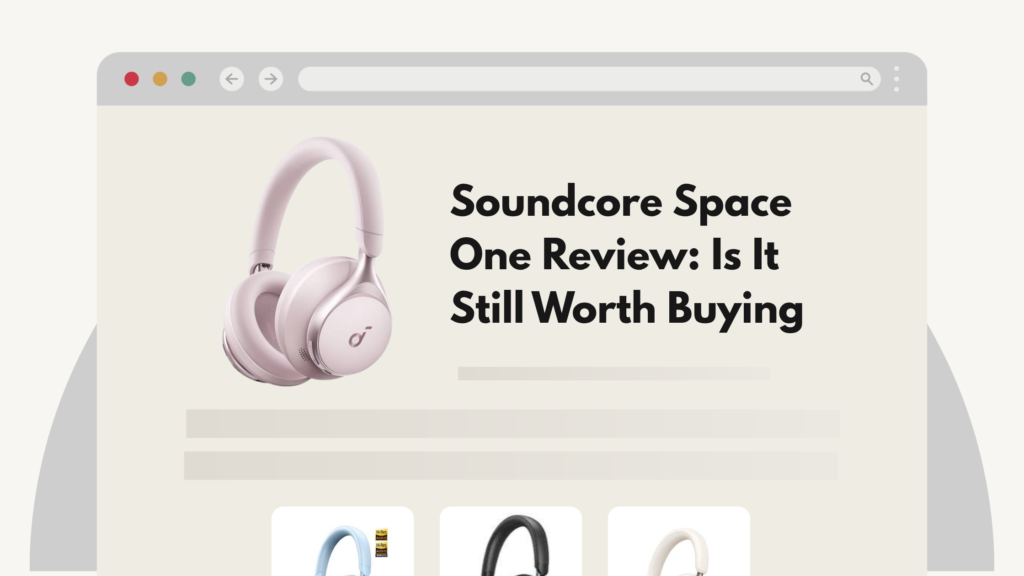
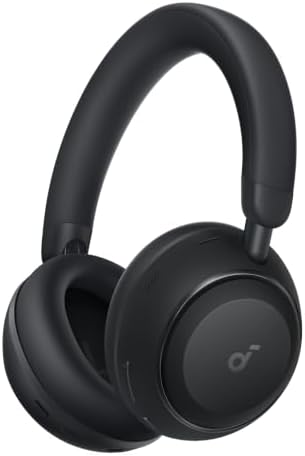
The Soundcore Space One is a wireless over-ear headphone built around active noise cancellation, long battery life and extensive sound customization. When it launched, it positioned itself as an affordable alternative to more expensive ANC headphones from Sony and Bose.
But there is an important 2026 update: Soundcore has since released the Space 2, which replaces the Space One in the company’s lineup. RTINGS has also updated its Space One review to reflect the newer model.
That does not automatically make the Space One a bad purchase. Its feature set remains competitive, particularly if you find it at a substantial discount.
Here is what you need to know before buying it.
Soundcore Space One Specs



| Feature | Soundcore Space One |
|---|---|
| Type | Over-ear wireless headphones |
| Drivers | 40mm |
| ANC | Adaptive ANC |
| Battery | Up to 40 hours with ANC |
| Battery without ANC | Up to 55 hours |
| Fast charging | 5 minutes for up to 4 hours |
| Bluetooth | Bluetooth 5.3 |
| Codecs | SBC, AAC, LDAC |
| Multipoint | Yes |
| Microphones | 3 with AI enhancement |
| Weight | 265g |
| Wired connection | AUX |
| EQ customization | Soundcore app / HearID |
| Carrying accessory | Travel pouch |
Soundcore lists up to 40 hours of playback with ANC enabled and up to 55 hours with ANC disabled. Its official specifications also include 40mm drivers, Bluetooth 5.3, LDAC, multipoint connectivity and three microphones with AI enhancement.
Design and Comfort
The Space One has a plastic-heavy construction, but it does not feel like an especially cheap pair of headphones.
At 265 grams, it is reasonably light for an over-ear ANC headphone. The ear cups rotate and the overall design folds down for travel.
Comfort is more complicated.
The headband and ear pads are reasonably comfortable for many users, but the ear cups are relatively shallow. RTINGS specifically found that the shallow padding can allow your ears to touch the driver housing, which can become uncomfortable during longer listening sessions.
Fit can also affect the sound.
If you wear glasses or have thicker hair, achieving a good seal around the ears can be more difficult. RTINGS notes that an inconsistent seal can cause noticeable changes in bass response.
So while the Space One is comfortable enough for general use, its fit is not one of its strongest characteristics.
Sound Quality
The Space One has a noticeably energetic sound signature.
RTINGS describes its default profile as V-shaped, meaning the headphones emphasize bass and treble while keeping the midrange somewhat less prominent.
That makes the Space One particularly enjoyable for music where bass is important.
Electronic music, hip-hop, pop and bass-heavy tracks can sound punchy and lively.
Vocals and instruments remain reasonably clear, but the presentation is not especially neutral. If you prefer a flat, studio-style sound, the default tuning may not be ideal.
The good news is that Soundcore gives you a lot of control.
Soundcore App and EQ
The Soundcore app is one of the Space One’s biggest advantages.
You can adjust the headphones’ sound profile using the equalizer, and the app includes a large selection of presets. There is also HearID, which is designed to personalize the sound according to your hearing profile.
RTINGS specifically highlights the Space One’s extensive sound customization as one of its strengths.
The headphones also support LDAC, which provides a higher-quality Bluetooth codec option on compatible Android devices. Soundcore lists SBC, AAC and LDAC among the supported codecs.
LDAC support is a useful feature at this price level, although actual results depend on the source device and listening conditions.
Noise Cancellation
Noise cancellation is one of the main reasons to consider the Space One.
Soundcore uses adaptive ANC that adjusts its noise-cancellation behavior according to surrounding conditions. The headphones also offer different listening modes through the app.
However, this is not an area where the Space One completely matches more expensive ANC headphones.
RTINGS found that the headphones can reduce mid- and high-frequency ambient noise reasonably well, but they struggle more with low-frequency sounds. That distinction matters on airplanes, buses and trains, where engine and road noise tends to sit heavily in the lower frequencies.
In other words, the Space One can make a noisy environment noticeably quieter, but you should not expect complete isolation.
Transparency Mode
Transparency mode lets outside sound through without requiring you to remove the headphones.
This is useful when you need to hear an announcement, talk to someone or remain aware of your surroundings.
The feature is convenient, but the overall experience depends on how naturally the external sound is reproduced. The Space One is primarily designed around affordable ANC rather than trying to reproduce the environment with the same refinement found on much more expensive headphones.
Battery Life
Battery life is one of the Space One’s strongest features.
Soundcore rates the headphones for:
- Up to 40 hours with ANC
- Up to 55 hours without ANC
- Up to 4 hours from a 5-minute charge
Those figures come from Soundcore’s own testing conditions.
RTINGS independently measured more than 34 hours of continuous playback and also describes the battery life as a strength for travel and office use.
That is plenty for long trips, workdays and regular daily listening.
If battery life is a major priority, the Space One still holds up well.
Call Quality
This is where the Space One is less impressive.
Soundcore uses three microphones with AI enhancement, but RTINGS found the microphone performance mediocre. In its testing, recorded speech could sound thin and robotic, and the microphone struggled in environments with significant background noise.
That makes the Space One better suited to music, podcasts and travel than to people who spend most of their working day on calls.
For occasional calls, it should be usable. For frequent conference calls, microphone quality deserves more consideration.
Multipoint Connectivity
The Space One supports multipoint connection, allowing it to remain connected to two devices.
This is particularly useful if you switch between a laptop and phone throughout the day.
For example, you can listen to music from your computer while keeping your phone connected. When a call comes in, you can switch over without completely disconnecting and pairing the headphones again.
Soundcore lists multipoint connectivity as one of the Space One’s supported features.
Travel Performance
The Space One makes sense as a travel headphone because of its combination of ANC and battery life.
The long battery runtime means you are unlikely to need frequent charging, while the foldable design makes it easier to pack.
There is one compromise: RTINGS notes that the headphones do not come with a hard carrying case. Soundcore lists a travel pouch among the included features.
A soft pouch offers some protection from scratches, but it does not provide the same level of protection as a rigid case.
Gaming
The Space One is not designed as a dedicated gaming headset.
RTINGS found that its Bluetooth latency is too high for gaming on PCs where timing matters.
Wired use is possible, but there are limitations, including the lack of microphone support through the analog connection noted by RTINGS.
For casual video watching, latency is less important. For competitive gaming, these are not the headphones I would choose.
Build Quality
The Space One’s construction is predominantly plastic, but RTINGS describes the build as reasonably well-built.
It does not have the premium material feel of significantly more expensive headphones, but the design is practical and relatively lightweight.
The lack of an IP rating also means these are not headphones you should treat as water-resistant sports headphones.
Soundcore Space One Pros and Cons
Pros
- Strong battery life
- Adaptive ANC
- LDAC support
- Multipoint connectivity
- Extensive EQ customization
- HearID personalization
- Lightweight at 265g
- Foldable design
- 40mm drivers
- Fast charging
Cons
- ANC is weaker with low-frequency noise
- Shallow ear pads can affect comfort
- Fit can affect bass response
- Microphone quality is only average
- No hard carrying case
- Not suitable for low-latency PC gaming
- Older model now replaced by Space 2
Soundcore Space One vs Space 2
This is the most important comparison to make in 2026.
The Space 2 is the direct successor to the Space One, and RTINGS describes it as the next generation. RTINGS says the newer model improves comfort, battery life, sound balance and noise isolation while maintaining a similar general build approach.
Soundcore’s newer Space 2 is rated for up to 70 hours without ANC and 50 hours with ANC, compared with 55 and 40 hours respectively for the Space One.
That means the Space One now needs to compete primarily on price.
If the Space One is only slightly cheaper than the Space 2, the newer model deserves serious consideration. If you find the Space One at a significant discount, its combination of ANC, LDAC, multipoint and long battery life can still make sense.
Is the Soundcore Space One Worth Buying in 2026?
The Space One is still a capable pair of wireless ANC headphones, but the answer depends heavily on its current price.
Its strengths remain clear: long battery life, strong customization, LDAC, multipoint connectivity and useful ANC.
Its weaknesses are equally clear. The ANC is not particularly strong with deep low-frequency noise, the ear cups are relatively shallow, microphone performance is mediocre, and the model has now been superseded by the Space 2.
That makes the Space One most interesting when it is available at a meaningful discount.
If you are paying close to the price of the newer Space 2, the generation difference becomes much more important.
Final Verdict
The Soundcore Space One remains a feature-rich budget-to-midrange ANC headphone, particularly for listeners who value battery life and customization.
Its 40-hour ANC battery rating, LDAC support, multipoint connection and extensive EQ options give it plenty of useful features. Its main compromises are the mediocre microphone, shallow ear cups and only moderate low-frequency noise cancellation.
The bigger question in 2026 is not whether the Space One is capable. It is whether its current price makes sense next to the newer Space 2.
For that reason, the Space One is best considered a discount-driven buy in 2026, rather than Soundcore’s current flagship option in this range.